Mudjacking · foam lifting · slab jacking
Concrete Lifting & Leveling in Kokomo
Before you pay to replace a sunken sidewalk, driveway panel or stoop, find out whether it can simply be raised. If the slab is in one piece, lifting usually costs a fraction of a tear-out.
Answer four questions about your slab. It's the same first pass we make on site, and it will tell you whether to call about lifting or start budgeting for replacement.
Can this slab be lifted?
1. Did the slab drop down, or get pushed up?
2. Is it still in one piece, or two or three large pieces?
4. Can you see where the water under it comes from: a downspout, the grade, a sump line?
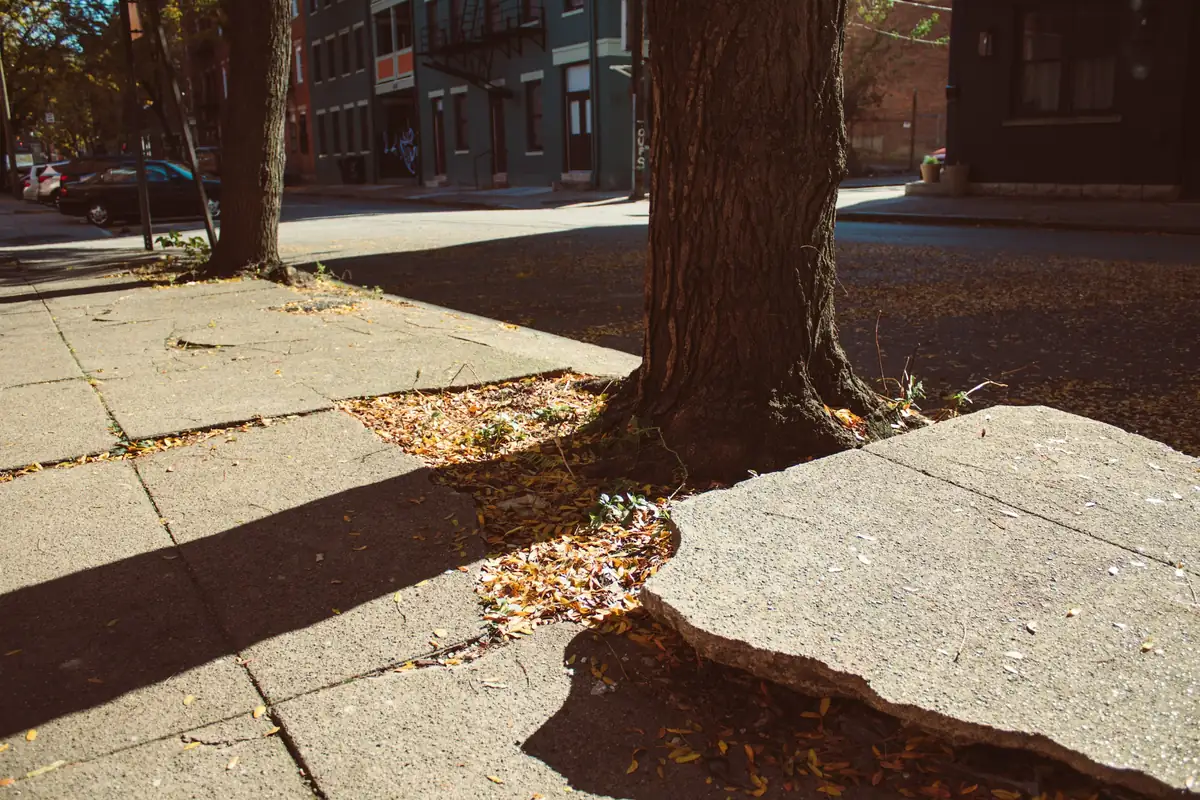
Lifting can't help a heaved slab.
Leveling only raises concrete. A slab pushed up by frost or a root is removed, the cause dealt with, and the panel replaced. Start with concrete repair for a single panel.
Lifting would just raise broken concrete.
The shattered panel gets replaced. Its whole neighbors may still be lifted to meet it, which keeps the job smaller than a full tear-out.
It may lift fine, but the surface needs its own fix.
Lift first, then decide about the top: a level, sound slab with a scaled surface is a candidate for resurfacing.
A good lifting candidate.
Lay a level or straight board across the drop, measure it, and send that photo with one of the downspout. Plan on fixing the water in the same visit.
Probably liftable, but find the water first.
Walk the slab in the next hard rain and watch where water goes. If it keeps running under the slab, it will sink again, foam or grout.
Concrete Leveling Near Me: What Can Be Lifted in Kokomo
Concrete leveling raises a sunken slab by filling the space under it until it comes back up. It works on most flatwork around a house:
- Sidewalk panels that dropped at a joint and became a trip edge
- Driveway panels sunk at the garage door or the walk
- Front stoops and steps pulling away from the house
- Patios sloping back toward the foundation
- Garage floor sections and aprons that settled after construction
- Pool decks with sunken or tipped panels
What it can't do: lower a slab that heaved up, glue a shattered slab back together, or fix a house foundation. Those get replaced or go to a structural repair.
Why Slabs Sink on Kokomo Clay
Howard County is flat glacial till, mostly Crosby and Brookston soils. Crosby is "somewhat poorly drained" with a perched water table as little as 6 inches down in wet season; Brookston can hold water at the surface. Those soils don't sink on their own. What sinks is what was put on top of them, and what water does to it:
- Backfill next to the house. The trench dug for the foundation gets refilled loosely, and the stoop, walk and garage apron are poured over it. It settles for years, which is why the slab at the house edge drops first.
- Downspout washout. A downspout emptying at the edge of a slab saturates the clay and carries fine fill out from under it.
- Frost cycles. Wet soil under a slab freezes and swells, then thaws soft. With about 131 nights a year at or below freezing in Kokomo, a slab over wet ground gets worked a lot.
- Voids nobody filled. Burrows, rotted roots and old construction debris leave holes that the slab eventually finds.
That's why every lift should end with the joints sealed and the water sent somewhere else. Otherwise you're paying to raise the same slab twice.
Mudjacking vs. Foam Lifting: An Honest Comparison
Foam-lifting companies tend to sell foam as the only answer and mudjackers do the reverse. Both work. They're good at different things.
| Mudjacking (slab jacking with grout) | Polyurethane foam lifting | |
|---|---|---|
| What goes under the slab | Cement-based slurry pumped under pressure | Two-part expanding polyurethane foam |
| Holes drilled | Larger holes | Small, about 5/8 in. |
| Weight added to the soil | Heavy; a foam maker's case study puts traditional fill materials at upwards of 120 lb per cu ft | Light, roughly 2–6 lb per cu ft in place |
| Back in use | 1–3 days to cure before heavy use | Minutes; one documented lane reopened in 20 |
| Typical life | About 8–10 years (HomeAdvisor) | Generally longer; less prone to washout |
| Published price | $3–$6 per sq ft | $5–$25 per sq ft |
| Best fit | Stable ground, big voids to fill, tighter budgets | Soft fill near foundations, where added weight would cause more settling, or when it has to be used today |
Either way, a lift is only as good as the soil below it. Fixr's cost guide is blunt about the limits: cracked or broken slabs need replacing, and mudjacking is a poor bet on expansive soil. If the ground is still moving, replacement over a proper stone base may be the better money.
Slab Jacking, Step by Step
Find why the slab sank
Downspouts, grade, sump discharge. If the water problem stays, the slab comes back down.
Drill injection ports in the slab
Small holes for foam, larger for grout, placed to lift evenly instead of rocking the panel.
Inject and watch the slab rise
Material goes in a little at a time while the slab is checked against a string line or laser, so it stops at level instead of overshooting.
Patch and seal
Ports are patched with cement grout; joints and cracks get a flexible sealant to keep water out from under the slab.
Redirect downspout water
Downspout extensions or a re-graded edge. Cheap, and the difference between a five-year fix and a long one.
Concrete Lifting Near Me: Where Kokomo Slabs Sink
Sidewalk trip edges
In Kokomo, the property owner is responsible for the sidewalk in front of the house, and city code asks owners to report defects to the Board of Public Works. A panel that dropped an inch at a joint can often be raised for far less than replacing it. If the walk is broken up, see sidewalk replacement and the city's 50/50 program.
Driveway panels at the garage
The panel next to the garage sits on the loosest backfill on the lot, so it's the one that drops. Lifting it back to the garage floor line also fixes water running toward the door. If the drive is broken across several panels, compare with concrete driveway replacement.
Patios tipping toward the house
A patio that now drains toward the foundation can usually be lifted at the house edge to restore the slope. For a patio that's cracked through or too small anyway, see concrete patio replacement and extensions.
Stoops and steps
A stoop pulling away from the house is often lifted and then caulked at the wall. Crumbling step edges and corners are a separate fix covered on concrete repair.
Floor Leveling vs. Slab Lifting: Which Do You Need?
"Floor leveling" means two different jobs. If a whole slab sank, it gets lifted from below. If the slab is where it should be but the surface is wavy or out of flat for new flooring, the fix is a self-leveling underlayment poured on top: a liquid floor leveler that flows out to a flat surface. That's flooring prep for tile, LVP or a basement finish, and it doesn't raise anything.
Garage floors can need either. A section that dropped along a crack is a lifting job; a garage floor that's sound but pitted and uneven before a coating is a grinding and patching job, covered with garage floor coatings.
Concrete Leveling Cost in Kokomo
Lifting is priced by the area raised and the material it takes, and voids are the wild card: you can't see how much space is under a slab until you start filling it. Expect a minimum charge, since a single step costs nearly as much to set up for as a full sidewalk run.
Compare against replacement: national guides put new flatwork at roughly $6 to $15 per square foot before tear-out, which is why lifting a sound slab is so often the better deal.
| Lifting job | Published range |
|---|---|
| Mudjacking per sq ft | $3–$6 |
| Polyurethane foam per sq ft | $5–$25 |
| Typical leveling job | $661–$1,883 (average $1,241) |
| 100 sq ft patio lift | $500–$1,700 |
Concrete Lifting and Mudjacking Questions
How long does concrete lifting last?
It depends on why the slab sank. HomeAdvisor's guide puts mudjacking at roughly eight to ten years; foam generally lasts longer because it's lighter and doesn't wash out as easily. Neither fixes the cause. If a downspout keeps dumping water under the slab, it will sink again, so redirecting the water and sealing the joints is part of the job.
Will the lifted slab crack?
Lifting puts stress on a slab, and an old slab with hidden cracks can open one up while it moves. A careful lift goes slowly and watches the slab with a string line or laser. Existing cracks usually stay visible after the lift; they get sealed afterward.
Can you lift a slab that heaved up?
No. Lifting only raises concrete. A slab pushed up by frost or a tree root has to be removed and the cause dealt with, which makes it a replacement job, not a leveling job.
Can my house foundation be leveled the same way?
Settling foundations are a structural repair with piers or engineered underpinning, not slab lifting. Flatwork against the house (stoops, walks, patios, garage aprons) is what slab lifting is for.
How soon can I use the slab after mudjacking or foam lifting?
Foam sets fast: in one documented highway job the lane was reopened about 20 minutes after injection. HomeAdvisor's guide allows one to three days for mudjacking grout to cure before heavy use. Walking on either is usually fine the same day.
Get a Concrete Leveling Estimate
Lay a level or a straight board across the sunken spot, measure the drop, and send a photo with it. Include a wider photo showing where the downspout empties. That's usually enough for a price range.
Lifting is one of the jobs our Kokomo concrete contractor crew handles alongside new pours, so if a slab can't be saved we can price the replacement in the same visit.